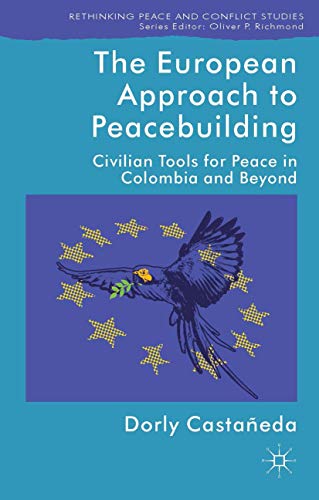
The European approach to peacebuilding : civilian tools for peace in Colombia and beyond / Dorly Castañeda.
Material type: TextSeries: Rethinking peace and conflict studiesPublication details: Hampshire : Palgrave Macmillan, 2014.Description: xvi, 256 pages ; 23 cmISBN:
 - 9781137357304 (hardback)
- European Union -- Politics and government
- Peace-building, European
- Peaceful change (International relations)
- Peace-building -- Colombia
- POLITICAL SCIENCE / History & Theory
- POLITICAL SCIENCE / Political Freedom & Security / International Security
- POLITICAL SCIENCE / Peace
- European Union -- Foreign relations -- Colombia
- Colombia -- Foreign relations -- European Union
- European Union countries -- Foreign economic relations -- Colombia
- 303.6/6 23
- JZ5584.E85 C375 2014
- POL010000 | POL012000 | POL034000

| Cover image | Item type | Current library | Home library | Collection | Shelving location | Call number | Materials specified | Vol info | URL | Copy number | Status | Notes | Date due | Barcode | Item holds | Item hold queue priority | Course reserves | |
|---|---|---|---|---|---|---|---|---|---|---|---|---|---|---|---|---|---|---|
 Books
Books
|
Salima Branch General Collection | NFIC | 303.66 CAS (Browse shelf(Opens below)) | Available | 0091164 |
Includes bibliographical references and index.
Machine generated contents note: -- Foreword; Jenny Pearce -- Introduction -- PART I: THE EUROPEAN UNION AS AN INTERNATIONAL PEACE ACTOR -- 1. European Development Aid Supporting Peace -- 2. The EU Decides to Support Peace in Colombia -- PART II: THE RECEPTION SIDE: ANTAGONIST EXPECTATIONS OF EU ACTIONS FOR PEACE -- 3. EU's Support for CSOs: Breaking Authoritarianisms -- 4. EU as the Perfect Ally for the War Against Terrorism -- PART III: EUROPEAN PEACEBUILDING AS A PROCESS -- 5. The European Union Learning Process on Peacebuilding in Colombia -- 6. Peacebuilding on the Ground: the European Approach -- Conclusions: the European Approach to Peacebuilding.
"Despite its multiple limitations as a peace actor, the EU has been able to contribute to peace in different countries affected by protracted conflict. Going further than the debate about what the EU should do, the kind of power it represents and the pertinence of the liberal peace building model, this book explores Colombia, and beyond, to understand how the EU has used Official Development Aid to work with Civil Society Organizations and recipient governments for peacebuilding.Castaneda focuses on the European capacities to support multiple transitions to peace and proposes both a handy definition of peacebuilding at the intersection of three dimensions: security, development and democracy, and a framework for analyzing complex dynamics in conflict-affected countries, useful for designing international action.Mobilising tools from peace and conflict studies, development economics, sociology, public policy and international relations, this book will be a valuable resource to a range of scholars, uniquely providing a consideration of both sides of the cooperation programme: the international actor and the recipient society. "--
There are no comments on this title.